


The Faith That Justifies Is an Obedient Faith
- Cougan Collins
- 4 days ago
- 9 min read

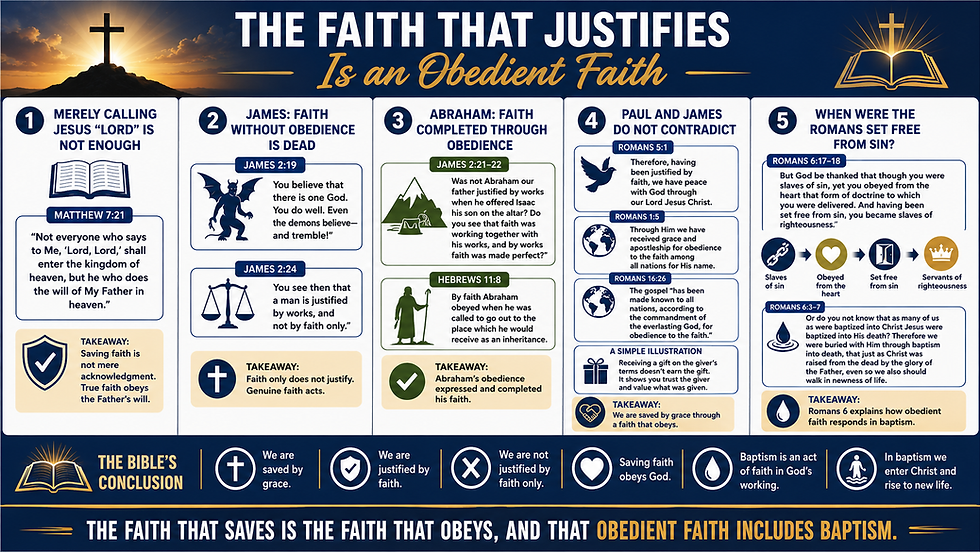
Jesus made it clear that merely calling Him “Lord” is not enough to save a person:
Matthew 7:21“Not everyone who says to Me, ‘Lord, Lord,’ shall enter the kingdom of heaven, but he who does the will of My Father in heaven.”
Jesus went on to describe people who had prophesied, cast out demons, and performed many wonders in His name. Yet He said to them, “I never knew you; depart from Me, you who practice lawlessness” (Matthew 7:22–23). Their religious claims and impressive works couldn’t replace submission to the Father’s will.
Therefore, saving faith is not merely acknowledging that Jesus exists or calling Him Lord. Saving faith trusts Jesus enough to obey Him.
James makes the same point:
James 2:19“You believe that there is one God. You do well. Even the demons believe—and tremble!”
The demons believe certain facts about God, but they are not saved. Their belief doesn’t lead them to loving submission and obedience. Mental agreement by itself is not saving faith.
James then uses the Bible’s only occurrence of the expression “faith only”:
James 2:24“You see then that a man is justified by works, and not by faith only.”
This statement couldn’t be clearer. A person is not justified by a dead, inactive faith that refuses to obey God. James is not teaching that human beings earn salvation by accumulating good deeds. He is teaching that genuine faith acts upon what God has commanded.
James uses Abraham as his example. Abraham believed God, but his faith was completed and demonstrated through obedience:
James 2:21–22“Was not Abraham our father justified by works when he offered Isaac his son on the altar? Do you see that faith was working together with his works, and by works faith was made perfect?”
Abraham’s obedience didn’t compete with his faith. His obedience was the expression of his faith. Faith was “working together” with his actions. Without obedience, his claim to believe God would have been empty.
This agrees perfectly with Hebrews:
Hebrews 11:8“By faith Abraham obeyed when he was called to go out to the place which he would receive as an inheritance.”
Notice the inspired wording: “By faith Abraham obeyed.” Faith and obedience are not enemies. Biblical obedience is what genuine faith produces.
Are Paul and James Contradicting Each Other?
Paul wrote:
Romans 5:1“Therefore, having been justified by faith, we have peace with God through our Lord Jesus Christ.”
Some conclude from this passage that a person is justified at the moment of belief alone, before repentance, confession, or baptism. However, Paul didn’t say that we are justified by faith alone. He said we are justified by faith.
James explains what kind of faith justifies: not a dead faith, not demonic belief, and not faith only, but an active and obedient faith.
Paul also contrasts faith with the works of the law and the works of human merit. He teaches that no one can earn salvation by perfectly keeping a system of law. Salvation is a gift of God’s grace, received through faith. However, receiving a gift on the giver’s terms doesn’t mean that the recipient earned it.
Suppose a person offers to pay another person’s debt but requires him to come to the bank and sign the necessary papers. Going to the bank doesn’t earn the money. Signing the papers doesn’t make the payment a wage. Those actions are simply the conditions for receiving the gift.
In the same way, belief, repentance, confession, and baptism don’t purchase salvation. Christ purchased salvation with His blood. Our obedience is the God-appointed means by which we accept His gracious offer.
This is why Paul repeatedly spoke of “the obedience of faith”:
Romans 1:5“Through Him we have received grace and apostleship for obedience to the faith among all nations for His name.”
Romans 16:26The gospel “has been made known to all nations, according to the commandment of the everlasting God, for obedience to the faith.”
Paul’s message was not salvation by faith without obedience. His message was salvation through an obedient faith.
When Were the Romans Set Free from Sin?
Paul explains the Romans’ conversion in the chapter immediately following Romans 5:
Romans 6:17–18“But God be thanked that though you were slaves of sin, yet you obeyed from the heart that form of doctrine to which you were delivered. And having been set free from sin, you became slaves of righteousness.”
Notice the inspired order:
They were slaves of sin.
They obeyed from the heart.
They were then set free from sin.
They became servants of righteousness.
Paul didn’t say they were set free from sin before they obeyed. They obeyed the gospel from the heart and were then set free. Their obedience was sincere and faith-filled, not an attempt to earn salvation.
What was the “form of doctrine” they obeyed? Earlier in the chapter, Paul describes the death, burial, and resurrection of Jesus and shows how believers obey that gospel pattern through baptism:
Romans 6:3–7“Or do you not know that as many of us as were baptized into Christ Jesus were baptized into His death? Therefore we were buried with Him through baptism into death, that just as Christ was raised from the dead by the glory of the Father, even so we also should walk in newness of life.
“For if we have been united together in the likeness of His death, certainly we also shall be in the likeness of His resurrection, knowing this, that our old man was crucified with Him, that the body of sin might be done away with, that we should no longer be slaves of sin. For he who has died has been freed from sin.”
Jesus died, was buried, and rose again. In baptism, the believer is united with that saving work:
The believer dies to sin.
The believer is buried with Christ in baptism.
The believer is raised to walk in newness of life.
Paul doesn’t describe baptism as a ceremony performed after new life has already begun. He says the believer is raised from baptism to “walk in newness of life.”
Justified from Sin in Baptism
There is an important connection between Romans 5:1 and Romans 6:7.
In Romans 5:1, Paul says that believers have been “justified” by faith. In Romans 6:7, the word translated “freed” comes from the same Greek verb commonly translated “justified.” Romans 6:7 can therefore be rendered:
“For he who has died has been justified from sin.”
The context identifies the death Paul is discussing. It is the believer’s union with Christ’s death in baptism:
Romans 6:3“As many of us as were baptized into Christ Jesus were baptized into His death.”
The sequence is clear:
We are baptized into Christ.
We are baptized into His death.
Our old person is crucified with Him.
The body of sin is done away with.
We are freed, or justified, from sin.
We rise to walk in newness of life.
Therefore, Romans 5 and Romans 6 don’t present two separate plans of salvation. Romans 5 teaches that justification is by faith. Romans 6 explains how that faith responds to the gospel and becomes united with Christ: through baptism.
The faith that justifies is the faith that obeys.
Baptism Is God’s Work, Not Human Merit
Some object that baptism cannot be necessary because it is a “work.” However, the Bible never describes baptism as a work of human merit by which a person earns salvation. Instead, baptism is an act of faith in what God does.
Colossians 2:12“Buried with Him in baptism, in which you also were raised with Him through faith in the working of God, who raised Him from the dead.”
Baptism is an expression of “faith in the working of God.” The power is not in the water, the person performing the baptism, or the moral worthiness of the one being baptized. The saving power belongs to God and to the blood of Christ.
The person being baptized is not boasting in his own work. He is trusting God to do what God promised.
This is also why baptism doesn’t contradict grace:
Ephesians 2:8–9“For by grace you have been saved through faith, and that not of yourselves; it is the gift of God, not of works, lest anyone should boast.”
Baptism provides no ground for boasting. A person being baptized is not presenting God with a record of perfect law-keeping. He is surrendering to God, admitting that he is spiritually dead and entirely dependent upon the death and resurrection of Jesus.
Faith is the means by which salvation is received. Baptism is the point at which that faith submits to God’s working and is united with Christ.
Baptism Places the Believer into Christ
Every spiritual blessing is found in Christ, including redemption and forgiveness:
Ephesians 1:3God “has blessed us with every spiritual blessing in the heavenly places in Christ.”
Ephesians 1:7“In Him we have redemption through His blood, the forgiveness of sins.”
The question, then, is how a believer enters Christ. Paul answers:
Galatians 3:26–27“For you are all sons of God through faith in Christ Jesus. For as many of you as were baptized into Christ have put on Christ.”
Paul begins with faith and then explains the faith-response by which people entered Christ: “For as many of you as were baptized into Christ have put on Christ.”
Faith doesn’t eliminate baptism; it leads the believer to baptism.
Romans 6:3 says we are baptized into Christ. Galatians 3:27 says we are baptized into Christ and put on Christ. Since redemption and forgiveness are in Christ, baptism cannot reasonably be dismissed as an optional symbol performed after salvation.
Jesus Joined Belief and Baptism to Salvation
Jesus said:
Mark 16:16“He who believes and is baptized will be saved; but he who does not believe will be condemned.”
Jesus placed belief and baptism before salvation:
Belief + baptism → salvation.
Some argue that Jesus did not say, “He who is not baptized will be condemned.” However, unbelief prevents baptism from being valid in the first place. A person who doesn’t believe will not submit to Christ’s command in saving faith. Jesus didn’t need to list every condition that unbelief makes impossible.
Consider a similar statement: “He who eats and digests his food will live, but he who doesn’t eat will die.” There is no need to add, “He who doesn’t digest will die,” because a person who refuses to eat will never reach the point of digestion.
Jesus clearly joined faith and baptism together as conditions preceding salvation. No one has the authority to separate what Jesus joined.
The Conversion of Three Thousand
On the Day of Pentecost, Peter preached the death, burial, resurrection, and lordship of Jesus. His hearers believed the message and were cut to the heart. They asked:
Acts 2:37“Men and brethren, what shall we do?”
Peter didn’t tell them that they were already saved because they believed. He answered:
Acts 2:38“Repent, and let every one of you be baptized in the name of Jesus Christ for the remission of sins.”
The people who gladly received the word were baptized:
Acts 2:41“Then those who gladly received his word were baptized; and that day about three thousand souls were added to them.”
Their response shows what it means to receive the word. They believed the message enough to obey it.
Approximately three thousand people were baptized that day. The apostles didn’t replace baptism with a man-made sinner’s prayer. They didn’t delay baptism for weeks or months. They did not treat it as an optional outward symbol for people who were already saved. They followed the command of Jesus.
The Pattern in Acts
The same pattern continues throughout the Book of Acts:
The Samaritans believed and were baptized (Acts 8:12).
Simon believed and was baptized (Acts 8:13).
The Ethiopian eunuch heard Jesus preached, confessed his faith, and was baptized immediately (Acts 8:35–39).
Saul was told, “Arise and be baptized, and wash away your sins, calling on the name of the Lord” (Acts 22:16).
Cornelius and his household were commanded to be baptized (Acts 10:47–48).
Lydia and her household were baptized after hearing the gospel (Acts 16:14–15).
The Philippian jailer heard the word, responded that same hour of the night, and was baptized immediately (Acts 16:30–34).
Many Corinthians heard, believed, and were baptized (Acts 18:8).
The Ephesians were baptized in the name of the Lord Jesus when they learned the truth (Acts 19:1–5).
The inspired record may not repeat every element of conversion in every account, but it never presents salvation as a faith that refuses to obey. Belief and baptism are repeatedly joined because baptism is the obedient response of faith to the gospel.
Baptism Saves Through Christ’s Resurrection
Peter wrote:
1 Peter 3:21“There is also an antitype which now saves us—baptism—not the removal of the filth of the flesh, but the answer of a good conscience toward God, through the resurrection of Jesus Christ.”
Peter explicitly says that baptism “now saves us.” He immediately explains that he is not talking about physically washing dirt from the body. Baptism saves because it is an appeal or response to God made possible “through the resurrection of Jesus Christ.”
Again, the power is not in water by itself. The power is in the crucified and risen Savior. Baptism is where the believer appeals to God in faith and is united with Christ’s saving death and resurrection.
The Necessary Conclusion
The Bible teaches all of the following:
We are saved by grace.
We are justified by faith.
We are not saved by works of merit.
We are not justified by faith only.
Saving faith obeys God.
Baptism is an act of faith in God’s working.
In baptism, we enter Christ and His death.
In baptism, the old person of sin is crucified.
In baptism, sins are washed away.
From baptism, we rise to walk in newness of life.
Baptism saves through the resurrection of Jesus Christ.
These truths don’t contradict one another. Together, they reveal God’s complete plan.
We are not saved because baptism earns salvation. We are saved by the grace of God and the blood of Christ when, through faith, we submit to the gospel conditions God has given.
Faith without obedience is dead. Faith alone doesn’t justify; rather, a living, obedient faith believes Jesus, repents of sin, confesses Him as Lord, and is baptized into Christ for the forgiveness of sins.
The question is not whether faith saves because it does. The real question is: What kind of faith saves?
The biblical answer is clear: the faith that saves is the faith that obeys, and that obedient faith includes baptism.


Comments